

Drywall plastering (Gib stopping)
Seamless plasterboard walls and ceilings for new installations, repairs and renovations — stopped and sanded to the level of finish the job actually needs.
Plasterboard arrives in sheets. Your job is to make it stop looking like sheets. Everything that happens between those two states — taping, bedding, coating, sanding — is stopping, and it is the single biggest influence on how the finished, painted room looks.
Get it right and the walls read as one continuous surface. Get it wrong and every joint shows up the first sunny afternoon, by which point the painting has already been done and paid for.
What we do
New builds — Full-house stopping worked to your programme and handed over paint-ready.
Renovations and extensions — New plasterboard blended into existing walls and ceilings so the join is not the first thing anyone notices.
Architectural — brings distinctive character and refinement to interior spaces. From elegant curves and bespoke ceiling features to intricate cornices and decorative mouldings, each element is carefully crafted to complement the architecture and create a seamless, sophisticated finish.
Ceilings — The least forgiving surface in the house, because of the way light crosses it.
Commercial fit-outs — Offices, retail and hospitality, scheduled around trading where required.
Make-good between tenancies — Fast, tidy repairs so a rental is not sitting empty longer than it has to.


Levels of finish — and why it matters to you
Not every wall needs the same standard, and paying for a top-level finish in a garage is money thrown away. The New Zealand plasterboard levels of finish exist to sort this out, and the two that matter for most homes are these:
-
Level 4 — The standard finish for most residential walls and ceilings. Suitable for flat and low-sheen paints in normal lighting conditions. This is what the majority of homes get and it is entirely appropriate for them.
-
Level 5 — A higher-grade finish with a skim over the full surface. Specified where critical lighting will fall across a wall — large windows, skylights, wall-washing downlights, long uninterrupted surfaces — or where a gloss or semi-gloss paint will be used. It costs more because it is more work, and in the right room it is the difference between a wall that looks flawless and one that looks patchy.
-
Lower levels — Used where the surface will be concealed or where appearance is not a factor, such as some garage, storage and service areas.
Our process
Check the linings. Sheet fixing, sheet edges and any movement in the substrate get looked at first. Stopping cannot fix a lining problem — it only hides it until it reappears.
Tape and bed. Joints reinforced and bedded, internal and external corners set out straight.
Build the coats. Successive coats, each wider than the last, feathered out so the joint blends into the sheet rather than sitting proud of it. Each coat dries properly before the next.
Sand. Sanded flat with dust controlled as far as practical.
Check under raking light. From more than one angle, before we call it finished.
Hand over paint-ready. Swept, tidy and ready for the painter — or for us, if we are doing that part too.

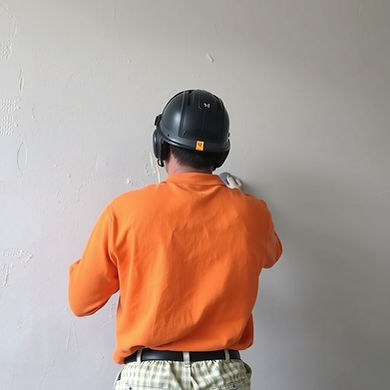
New decorative work
Fibrous plastering is not only for period homes. Plain modern rooms with high ceilings and big wall areas often feel unresolved, and a well-chosen cornice or a coffered detail does more for the room than furniture will. Because the profile is made rather than bought, it can be scaled to suit the room instead of forcing the room to accept a standard size.
Worth knowing: profile scale matters more than profile style. A deep, ornate cornice overwhelms a low-ceilinged room, and a mean little cove disappears in a large one. We will tell you what suits the space, including when the answer is nothing at all.